
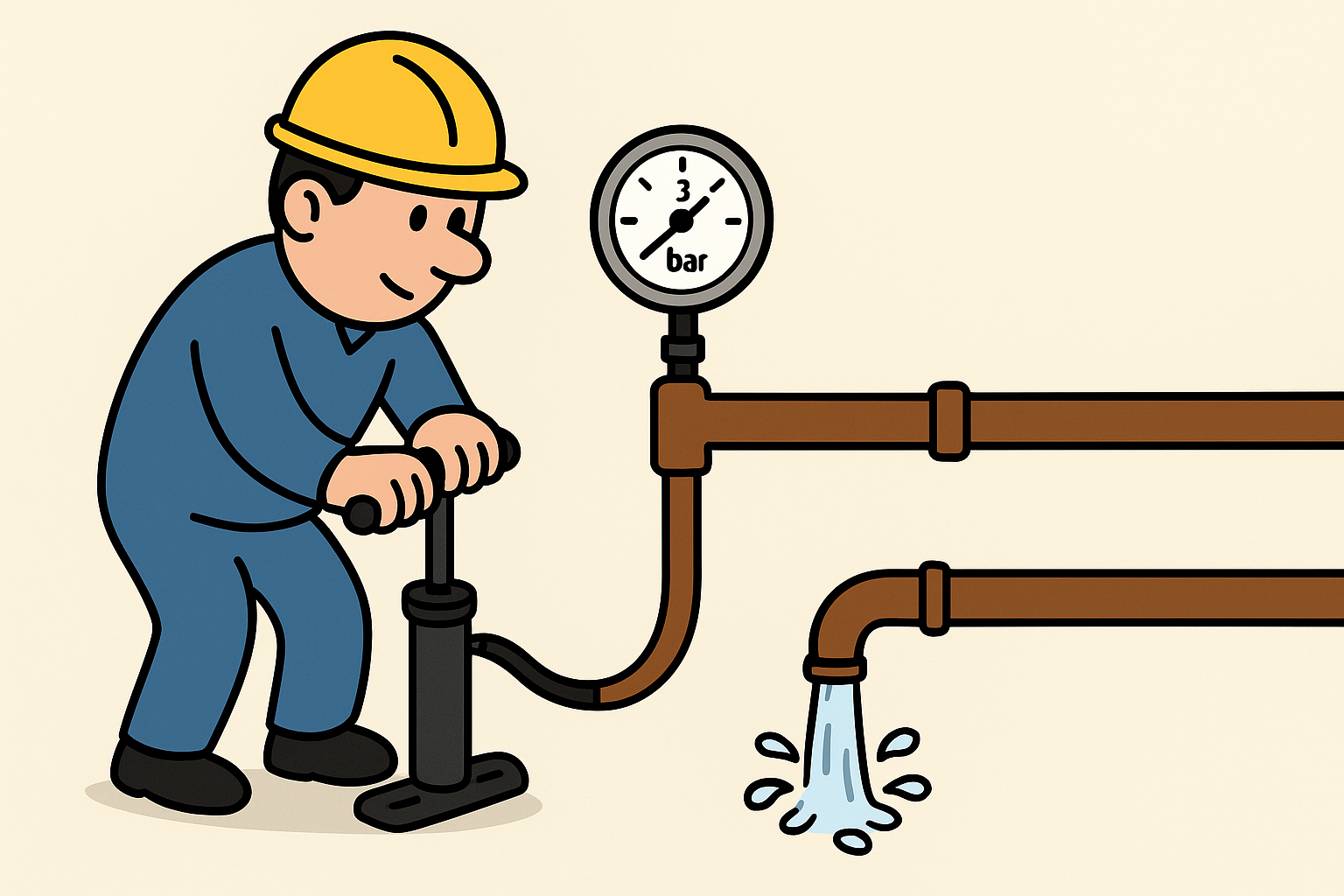
Hydraulic Tests – What They Are and Why They Are Needed
Hydraulic testing is the process of checking a system with water under increased pressure to ensure that pipelines, joints, radiators, heat exchangers, and other equipment are tight, leak-free, and can withstand the design pressure.
These tests are performed:
- on newly installed systems before commissioning;
- after repairs or replacements (e.g., radiators or pipes);
- periodically – as a preventive measure before the heating season.
Hydraulic tests help prevent accidents, leaks, and costly repairs in heating or water supply systems.
🏠 Hydraulic Test in a Private House
1. System Preparation
- The system is filled with water through the lowest point.
- Air is released from all high points (through automatic or manual vents).
- Check that all valves, pumps, boiler, expansion tank, and other equipment are properly connected.
- The system temperature should be close to ambient – neither hot nor frozen.
2. Pressure Increase
- A hydraulic pump (manual or electric) is used.
- Pressure is gradually increased:
- Private house radiator heating system – up to 1.5 times the working pressure (e.g., working 2 bar → test 3 bar).
- Underfloor heating system – according to project specifications, usually 3–4 bar.
- Central heating network pipelines – according to operator instructions, usually 10–25 bar.
- Pressure is often increased 2–3 times because it may drop slightly the first time due to air release or pipe expansion.
3. Monitoring and Holding Time
- Once the required pressure is reached, the system is maintained for a specified time:
- Private house – 30–60 minutes.
- Underfloor heating – at least 24 hours.
- Central network – 30–60 minutes, depending on the operator.
- The pressure gauge is monitored – pressure must remain stable.
- Allowable pressure drop – no more than 0.1 bar per 30 minutes (for house systems).
- Visually inspect all joints and equipment for moisture, dripping, or leaks.
4. After the Test
- If the pressure remains stable – the system is considered tight and ready for use.
- If a pressure drop or leak is observed – defects are corrected and the test is repeated.
- After the test, water can be drained or left in the system if it will be operated soon.
🧱 Hydraulic Test for Underfloor Heating
The underfloor heating system must be tested before concrete pouring. This ensures:
- pipes are intact and leak-free;
- pipes are filled with water during concrete pouring to prevent deformation due to temperature changes or load.
Requirements:
- Pressure – according to project specifications, usually 3–4 bar.
- Holding time – at least 24 hours.
- Pressure must remain stable throughout the period.
🏢 Hydraulic Tests by “Vilnius Heat Networks”
Purpose
“Vilnius Heat Networks” (VŠT) conducts annual hydraulic tests of centralized heat supply pipelines to ensure city pipelines are strong and leak-free before the new heating season.
These tests allow early detection of weak points and prevent accidents that could leave entire districts without heat during winter.
When Conducted
- Usually spring–summer (May–September), when heating is turned off.
- Residents are informed in advance about test dates via notices in staircases, email, or VŠT website.
Preparation Before the Test
- Close inlet valves between the city network and internal system to prevent high pressure from entering the building’s heating system.
- Drain water from internal circuits if indicated in the notice.
- Check that the heat station (heat exchanger, pumps, automation) is isolated from the city network.
- Inform residents that hot water will be unavailable on that day – this is normal because heating is paused during the test.
How the Test is Conducted
- Water is pumped into the heating pipelines.
- Pressure is maintained for the specified time (30–60 min).
- Check that pressure does not drop and there are no leaks in the pipelines or manholes.
If leaks are found, the pipeline is isolated, the defect is fixed, and the test is repeated.
Why Preparation is Necessary
If a building does not isolate its heating system during city tests:
- excessive pressure (up to 16–20 bar) may enter the internal system;
- radiators, pipes, or heat exchangers may be damaged;
- repair costs are borne by the building owner or manager.
Therefore, isolation is mandatory.
📋 Summary Table
| System | Working Pressure | Test Pressure | Holding Time | Notes |
|---|---|---|---|---|
| Private house radiator heating system | 2–3 bar | 1.5× working (3–4.5 bar) | 30–60 min | Pressure increased gradually, gauge monitored |
| Underfloor heating | 1.5–2.5 bar | According to project (3–4 bar) | ≥24 h | Before concrete pouring, pipes filled with water |
| Central heating networks (VŠT) | 6–12 bar | 10–25 bar (according to operator) | 30–60 min | Internal systems disconnected to prevent building damage |